I’m sure you’ve heard about bio-mechanics; fancy words such as ‘coefficient of restitution’ & ‘radius of gyration’ without really understanding the concepts behind it. This article should help shine some light on the most basic concepts in bio-mechanics and demonstrate their application to golf.
Rotation & X-factor
You may have come across this idea before, I even mentioned this in a previous blog post. However, we will explore this concept in more detail now.
If you remember, X factor is the angle created between the maximum rotation of the shoulders against the maximum rotation of the hips, as seen below.
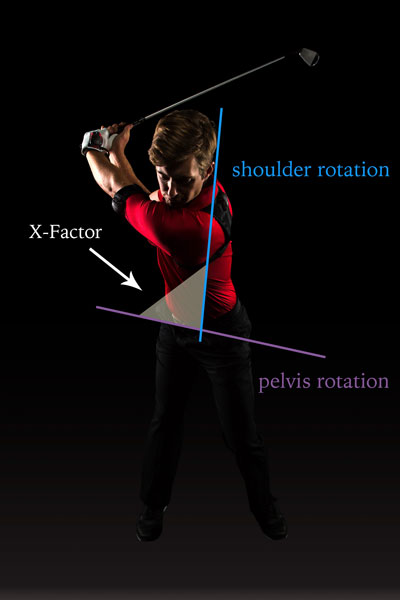
The X-factor is important for creating stretch between the upper body and the lower body. Like an elastic band, the bigger the X-factor, the more the band is stretched, the more elastic potential energy is stored in the body. Once the downswing commences, the band ‘snaps’ and all elastic potential energy is transferred into kinetic energy. Therefore, a clear causal link can be proven between X-factor and club head speed. However, keeping shoulder rotation constant and decreasing hip rotation will not lead to any distance gain, as the overall rotation has decreased. It is much more effective to keep hip rotation the same and increase upper thoracic rotation as this will increase X-factor and increase aggregate rotation.
Center of pressure
This is simply how your mass is being distributed onto the ground.
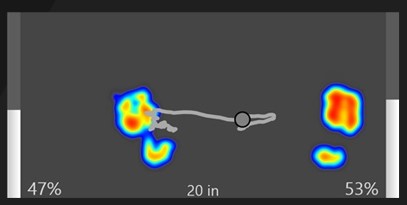
In the above picture, the red area is the area with the most force being applied downwards into the ground. The blue area is the area with the least force being applied, while the grey circle is the center of pressure. The grey trail is the path of the CoP, and its movement during the swing. The percentage bars on the left and right hand side of the picture is the weight differential between the left and right foot. Now we will look at the different stages of the swing, and see how the diagrams should differ.
Address
All areas should a similar shade of yellow with the CoP in the middle. Weight differential should be around 50-50 depending on club and lie.
Backswing
The right heel should be darker than any other area, with the weight differential higher in regards to the right side. The CoP should begin a path towards the right heel.
Downswing
CoP should begin movement away from the right side and begin transitioning towards the left side. Weight differential should be slightly higher in the left side, with more force being exerted downwards and towards the target
Impact
CoP should almost be in the right foot and slightly towards the heel with weight differential at 90% in the left foot.
Follow-through
CoP should be completely in the left foot with weight differential at almost 100% in the left foot. The only force from the right foot being exerted should be from the toe.

This link will take you to the maker of the above diagram, as they will have more information on this topic if you are interested.
https://www.youtube.com/user/SwingCatalyst/videos
Lateral movement
Also known as ‘slide’, this could add speed, as it contributes to the velocity of the swing, and (if executed properly) has been proven to add speed. However, many professional coaches condemn this movement as it causes many other flaws which is why few tour players use it.
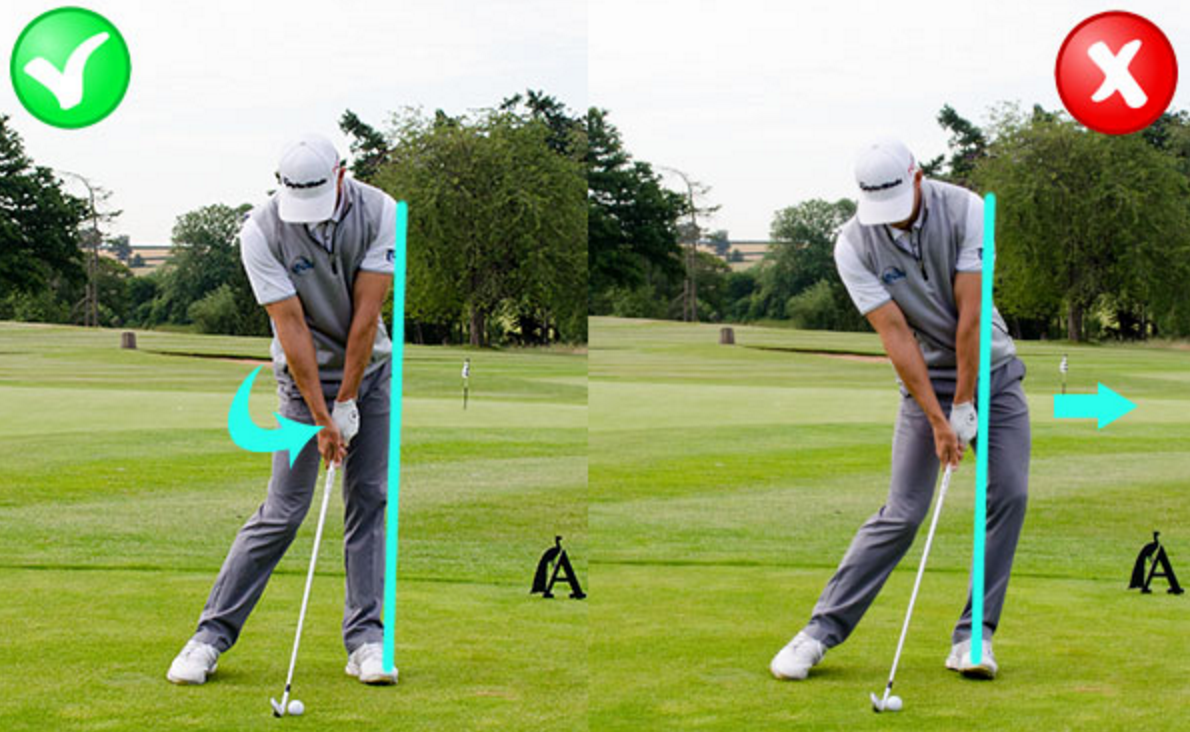
During the ‘slide’ your center of gravity shifts towards the target by a small amount. This may seem insignificant, but this has many knock-on effects. Shifting the center of gravity forwards will create space near your right toe for the club to reenter towards the ball. This will cause the swing direction to be more positive as a result of the club path being bigger. This, especially combined with the possibility of an open face angle can create massive blocks or hooks.
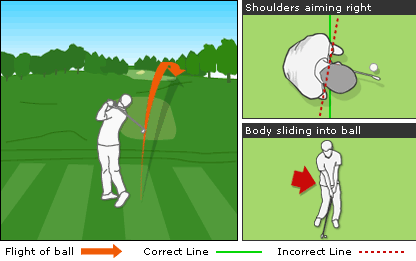
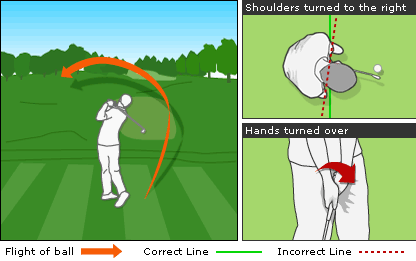
‘Sliding’ could theoretically increase distance (not only through increased speed) as the forward CoG would result in a lower dynamic loft. This would lower the spin loft which would (theoretically) increase smash factor (efficiency). However, on the flip side, a CoG more forward would increase the low point and cause a steeper swing which could reduce distance due to higher spin rate. As you can see, this can get very complicated very quickly, and every effect has a reason why it wouldn’t work, or not work as well.
 The Art of Golf
Another great article Jonathan! You definitely should get into writing as the command of English is fantastic. Particularly admire how all technical aspects are fully explained and accessible to someone with a more limited understanding of golf.
LikeLiked by 1 person
Thank you! I tried to keep it as simple as possible!
LikeLike