I’m sure you’ve been in a high pressure situation where you have had a putt, and it just slipped by. If not, you can imagine the feeling; your heart sinks but the putt does not. This article should help to illustrate some key concepts that are often overlooked by golfers of all ability.
Speed
This concept is one of the more obvious ones: the faster/harder you hit a putt, the less it will break. Also the slower/softer you hit a putt, the more it will break as shown by image below.
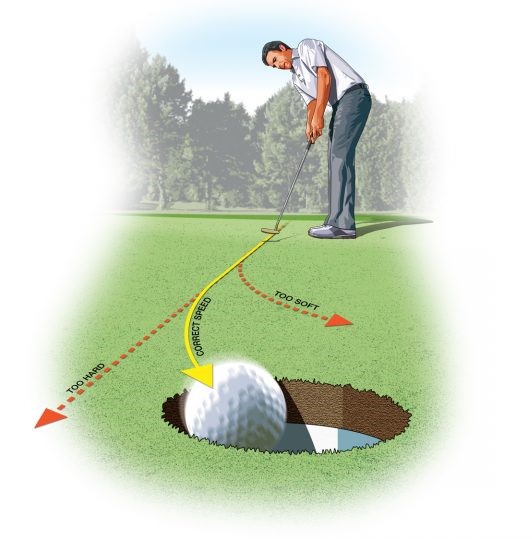
This is simply because the faster a putt rolls, the less time gravity has to cause a reaction on the ball, hence the straighter nature of ball’s path. Speed is so important that according to Dave Pelz’s Putting Bible, most missed putts are due to a misjudgement of speed, and not line. This is why most tour players take several practices strokes before striking a putt, just to confirm the pace of the putt.
Grain
This is a slightly more overlooked factor than speed, and very few golfers know and adjust accordingly to the grain of the green. Essentially, grain is the direction that the grass grows in, and while it may seem that it has a miniscule effect on the putt’s path, it can change whether a putt goes in or not. Grain has the same effect as slope on a green; if you putt into grain, the ball will decelerate quicker, and if you putt with the grain, the putt will decelerate slower. Additionally, if you putt across the grain, the putt will most likely follow the grain downwards.
The way to read grain on putts is to look for the burnt edge of the hole.
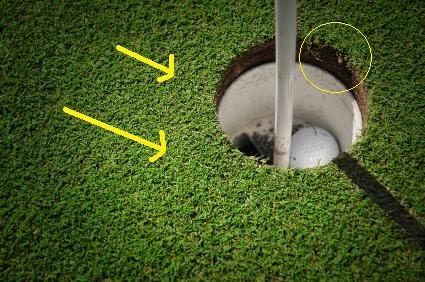
Grain is going to have a much more noticeable effect on slower greens, as the length of grass tends to be much longer.
Entry to the hole
If you were to ask most golfers, ‘Which part of the hole should you try and enter?’ Most people would say ‘the middle’. This makes sense, right? Well not necessarily, as if you think about it, the golf ball rarely moves in a straight line, as most putts are curved putts. This means that as the ball curves towards the hole, it tends to be moving more laterally the more curvy the putt is. This could result in a lip-out even if the ball enters the periapsis of the hole.
 The Art of Golf
Wow! Intriguing! Especially reading about the grain which is something I’d never thought about! Thank you for the expert teaching!
LikeLiked by 1 person
Yeah, grain is a feature which is often overlooked although it can make all the difference!
LikeLike
Great job going beyond the obvious. Excellent connection between speed, direction and grain!
LikeLiked by 1 person